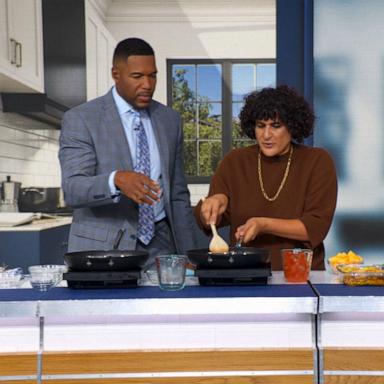


Chef Mia Castro joined "Good Morning America" on Tuesday to share a taste of her Puerto Rican heritage on a plate.
Castro, who spent her early career working under prestigious chefs such as José Andrés, Thomas Keller, and Wolfgang Puck, went on to become a private chef globally and recently penned her first cookbook.
"Cocina Puerto Rico: Recipes from My Abuela's Kitchen to Yours," is full of dishes that Castro adapted from her grandmother Sara's kitchen in San Juan.
Check out the full recipes below.
Serves 4
Ingredients
1 1/2 pounds bone-in, skin-on chicken thighs or drumsticks
3 teaspoons adobo, homemade (page 36) or store-bought
3 to 4 tablespoons olive oil
1 cup sofrito
3 pimento-stuffed green olives, minced, plus 1 tablespoon brine from the jar
2 cups uncooked medium-grain white rice
2 teaspoons sazón
2 1/2 cups chicken broth
1/4 cup finely chopped fresh cilantro, plus more for serving
Pique, for serving (optional)
Directions
Preheat the oven to 400 F. Line a baking sheet with parchment paper.
Remove the skins from the chicken pieces and stretch them out flat in a single layer on the prepared baking sheet. Cut the meat from the bones and place the bones on the baking sheet as well.
Cut the chicken meat into 2-inch chunks and place in a large bowl.
Sprinkle the skins and bones evenly with 1 teaspoon of the adobo. Bake for 10 to 15 minutes, until the skins are golden brown and crispy.
Transfer the skins to a paper towel-lined plate to drain and cool to room temperature. Store the chicken skin chicharrones in a dry airtight container. Reserve the bones.
Sprinkle the chicken meat with the remaining 2 teaspoons adobo. Using clean hands, massage the adobo into the chicken until well coated. Let stand at room temperature for 15 to 20 minutes or cover and refrigerate for up to 2 hours.
In a large pot, heat the olive oil over medium heat. Add the chicken and cook until golden brown on all sides, about 10 minutes. Transfer the chicken to a large plate.
In the same pot, combine the sofrito, olives and olive brine. Cook, stirring, until most of the moisture evaporates, 2 to 5 minutes.
Add the rice and sazón and cook, stirring, until the rice is hot to the touch, 2 to 4 minutes more.
Add the broth and reserved chicken bones and bring to a boil, then immediately reduce the heat to low. Stir, then arrange the chicken (and any juices) in an even layer on top of the rice.
Cover and cook for 15 minutes -- do not lift the lid. Remove from heat, stir the chicken into the rice, and discard the bones. Cover again and let stand for 10 minutes.
Uncover and stir in the cilantro.
Serve the rice in bowls. Crush some of the chicken skin chicharrones with your hands and sprinkle on top. Finish with more cilantro. Add a few drops of pique if desired.
Makes 15 bars
Ingredients
1/2 cup (1 stick) unsalted butter, cut into 8 cubes and chilled
1 small ice cube
Nonstick cooking spray
1 1/2 cups all-purpose flour
1 1/2 teaspoons baking powder
1/2 teaspoon salt
1 cup granulated sugar
1 teaspoon pure vanilla extract
1/4 teaspoon almond extract
3 large eggs, at room temperature
6 to 8 ounces guava paste (see page 20), thinly sliced (about 1/8 inch thick)
1/4 to 1/2 cup powdered sugar, for dusting
Directions
In a small saucepan, melt half the butter over medium heat, then cook, swirling continuously, until it browns, becomes foamy, and develops a toasty, nutty aroma, 1 to 2 minutes. Immediately scrape the brown butter into the bowl of a stand mixer fitted with the paddle attachment (or a large bowl if using a handheld mixer). Add the ice cube and the remaining unmelted butter and stir until fully melted. Let cool to room temperature, 20 to 30 minutes. (To cool faster, refrigerate 5 to 10 minutes until soft and spreadable.)
Place a rack in the middle of the oven and preheat to 350 F. Spray a 9‑inch square baking pan with nonstick spray, then line it with parchment paper, leaving a 2- to 3‑inch overhang on two sides. Spray the exposed sides again.
In a medium bowl, whisk together the flour, baking powder and salt.
Add the sugar to the cooled brown butter and beat on medium‑high speed until light, fluffy, and pale (it will look a bit grainy, like whipped body scrub), 3 to 5 minutes, stopping to scrape the sides and bottom halfway through. Scrape down again, then add the vanilla, almond extract, and the eggs, one at a time, mixing on medium‑low until each egg is fully incorporated before adding the next. Beat on high until fluffy and silky, 1 to 2 minutes, then scrape the bowl. With the mixer on low, add half the flour mixture and mix just until incorporated. Repeat with the remaining flour mixture, being careful not to overmix.
Scoop half the batter into the prepared pan and spread it into an even layer. Arrange the slices of guava paste in a single even layer over the batter. Scoop the remaining batter on top and spread to cover the guava completely. Bake 30 to 35 minutes, until the top is evenly light golden and a toothpick inserted in the center comes out clean. Cool completely, 30 to 40 minutes.
Dust the cooled cake generously with powdered sugar. Use the parchment overhang to lift it out of the pan and transfer to a cutting board. Cut into squares with a serrated knife (trimming edges if you like). Serve with cafecito.
Serves 4 to 6
Ingredients
Dumpling masa
2 medium green plantains, peeled and cut into 1-inch chunks
2 teaspoons adobo, homemade (page 36) or store-bought
Asopao
1/4 cup olive oil
1 cup 1/2-inch-diced ham steak (about 6 ounces; optional)
3/4 cup sofrito
2 cups small-diced fresh tomatoes (about 1 large), or one 14.5-ounce can stewed tomatoes
4 pimento-stuffed olives, minced
15.5-ounce can pigeon peas, undrained
2 quarts chicken broth
1/2 cup uncooked medium-grain white rice, or 2 to 3 cups cooked
Salt (optional)
1/4 cup chopped fresh cilantro, plus more for serving
2 ripe Hass avocados, sliced
Directions
Make the dumpling masa: In a blender or food processor, combine the plantains and the adobo. Blend or process on high speed until a smooth paste forms, 2 to 4 minutes, scraping the sides with a rubber spatula as necessary. Use the blender tamper to help things along, if needed, but don't add water or liquid. (Alternatively, grate the plantain in a circular motion on the zesting side of a box grater until a smooth, slimy paste forms. Transfer it into a bowl, add the adobo, and stir until homogeneous.)
Make the asopao: In a large pot, heat the olive oil over medium-high heat. Add the ham (if using) and cook, stirring, until it's golden, 2 to 4 minutes. Add the sofrito and cook, stirring, until the moisture has evaporated, 2 to 4 minutes more. Add the tomatoes and olives and cook, stirring, until the moisture has evaporated, 2 to 4 minutes more. Add the pigeon peas with their liquid, broth, and uncooked rice (if that's what you're using), and bring to a boil, then immediately reduce the heat to maintain a simmer. Taste for seasoning. It should have hints of the herbaceous sofrito and sweet tomatoes. If necessary, add salt pinch by pinch, stirring and tasting after each addition, until the flavor is to your liking.
Using a scoop (or two small spoons), drop teaspoon-size portions of the masa directly into the hot broth until you've used all the masa. If you're using cooked rice, add it now. Stir the soup gently, cover, and cook over low heat until the rice is fully cooked and the soup has thickened, 15 to 20 minutes. Taste again and adjust the seasoning with salt, if necessary. Stir in the cilantro.
Serve the asopao in large bowls with a slice or two of avocado and some cilantro on top.
Serves 8 to 10
Ingredients
3 1/3 cups fresh coconut milk (page 77) or two 13.5‑ounce cans full‑fat coconut milk
1/2 cup sugar
1 teaspoon salt
1 cinnamon stick (optional)
2 slices fresh ginger (about 1 inch wide and 1/4 inch thick; optional)
1/3 cup plus 2 tablespoons cornstarch
Ground cinnamon, for garnish (optional)
Directions
In a medium pot, combine the coconut milk, sugar, salt, cinnamon stick (if using), and ginger (if using). Bring to a boil over high heat, then immediately reduce the heat to low and simmer for 2 minutes. Remove from the heat, cover, and steep for 20 minutes. (If not using the cinnamon and ginger, you can skip the steeping.)
If you're making individual servings, line up about ten 3 to 4‑ounce ramekins, or have a 1 1/2‑quart nonstick mold or glass container ready.
In a small bowl, whisk the cornstarch with 1/3 cup water until smooth to make a slurry. If you used the cinnamon and ginger, remove them from the steeped coconut milk. Bring the coconut milk back to a simmer over medium heat. While whisking, slowly pour in the cornstarch slurry.
Cook, whisking continuously, until the mixture thickens, resembles mayonnaise, and forms slow, thick bubbles, 3 to 5 minutes.
Remove from the heat and quickly pour or scrape the mixture into the mold(s) (it will begin to set quickly). Cover immediately with a lid or plastic wrap to prevent a skin from forming. Refrigerate for at least 6 hours or up to 1 week.
You can serve tembleque directly from the ramekins, but it's more fun to unmold it. To unmold, run a knife gently around the edges. Place a plate on top of the mold, invert swiftly, and release. If it sticks, slide the knife in slightly to break the air seal. For intricate molds, dip the bottom briefly in warm water, then invert again.
Garnish with a light dusting of cinnamon, if desired. Slice if using one large mold and serve.
Recipes reprinted with permission from "Cocina Puerto Rico" © 2026. Published by Union Square & Co., an imprint of Grand Central Publishing, a division of Hachette Book Group. Photography by Johnny Miller.
'GMA' kitchen picks
By clicking on these shopping links, visitors will leave ABCNews.com and Goodmorningamerica.com, and these e-commerce sites are operated under different terms and privacy policies. ABC will receive a commission for purchases made through these links. SOME PRICES ARE DYNAMIC AND MAY CHANGE FROM THE DATE OF PUBLICATION.