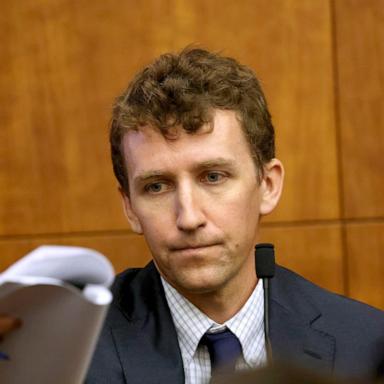


The defense attorneys for Lindsay Clancy, the Massachusetts woman charged with killing her three young children, have filed a motion today to dismiss the murder case against her.
On Monday, defense attorneys Martin Weinberg and Kevin Reddington argued that a mistrial would violate double-jeopardy protections. By invoking double jeopardy, Clancy's attorneys argue that the circumstances of that mistrial prevent prosecutors from putting her through another trial on the same charges.
The filing comes after Reddington asked Judge William Sullivan -- the judge overseeing Clancy's murder trial -- to question a holdout juror about his "truthfulness" during the jury selection process, as well as some of his actions during deliberations.
In their motion to dismiss, Weinberg and Reddington argued that Sullivan failed to properly probe whether the holdout juror failed to follow the instructions on reasonable doubt and thus "extinguished a viable alternative to the declaration of a mistrial."
Reddington also requested that the court preserve the confidential jury questionnaires from the trial, as well as review the juror's phone records, according to a motion filed last week, released by the court Monday.
“Ms. Clancy, like all criminal defendants, had a Constitutional right to have her fate decided by an impartial jury of her peers, faithfully applying the law as instructed rather than superimposing the juror's own view of legal right and wrong, including the foundational principle that, absent proof beyond a reasonable doubt of her guilt, she must be acquitted,” the attorneys wrote.
Clancy's five-week trial ended in a mistrial on Sept. 4, after jurors failed to reach a unanimous verdict.
Several jurors who have spoken publicly since the trial say that seven days of deliberations yielded an 11-1 split in favor of not guilty by reason of insanity. They claimed the final juror would not change his position favoring conviction, despite what they described as expressions of reasonable doubt.
Following criticism from other jurors, the holdout juror came forward publicly last week to defend his actions.
"I didn't have any doubts," Michael Péguy Desronvil said in a statement to ABC News shared by his attorney on Sept. 18. "As I tried to explain different possible theories during deliberation, I kept getting cut off as if I had doubts based on the evidence presented."
He continued, "Based on all the physical evidence, key witnesses, and what the prosecution presented, I thought it was enough proof that she (Clancy) knew exactly what she was doing and planned."
Clancy pleaded not guilty to three murder charges for the deaths of her 5-year-old daughter Cora, 3-year-old son Dawson and infant son Callan, who were strangled at the family's home in Duxbury, a Boston suburb, on Jan. 24, 2023.
The former nurse attempted suicide on the night of her children's deaths, leaving her paralyzed and in a wheelchair, according to state prosecutors.
Much of the testimony in Clancy's trial centered on whether or not she was suffering from postpartum psychosis-- considered a psychiatric emergency, according to the American College of Obstetricians and Gynecologists -- when she strangled her children and attempted to take her own life, and whether she should be held criminally liable for the killings.
Prosecutors argued that Clancy was criminally responsible for the children's deaths and was capable of understanding the severity of her actions.
Reddington's new motion comes ahead of a Sept. 29 court conference in the case -- when prosecutors could announce whether they plan to retry the case -- and a motion Reddington has said he will file to throw out the case based in part on the holdout juror's actions.
Plymouth County District Attorney Timothy Cruz has not said publicly whether he plans to retry Clancy. ABC News has reached out to Cruz's office for comment on the new motion from Reddington.
In the motion, Reddington specifically asked the court to preserve the original questionnaires for the 12 jurors and six alternates, every jury note, the recordings of some sidebars, court-officer logs, and sign-in sheets for the jurors' mobile devices. He also requested video from the jury-room corridor from the deliberations.
The records would be reviewed by the court "in camera," which means they would not be accessible to the public.
Reddington also requested records from Desronvil's mobile phone, including his call and text records, as well as data-session logs. He also requested that Desronvil turn over his phone to the court so it can be examined.
Once all those records are turned over, Reddington requested that the court question Desronvil about his "the truthfulness of the questionnaire and voir dire answers," his assurance to the court on Sept. 3 that he was following the instructions, and his use of his phone during the deliberations. The questions would not touch on the substance of the deliberation, the motion said.
ABC News has reached out to Desronvil's attorney for comment.
Juror Nick Dargie previously told ABC News' Aaron Katersky that Desronvil at times declined to engage with jurors during the deliberations and instead scrolled on his phone.
"There was times he wouldn't engage, like he'd be scrolling on his phone while people are talking to him, things like that, where he's just not paying attention," Dargie said at the time.